Cloud and infrastructure scope
AWS, Azure, GCP, Kubernetes, Terraform, Pulumi, Ansible, and service count all help reviewers understand scale and environment.
DevOps and SRE roles vary by stack, cloud environment, and organizational maturity. A platform engineering role at a hyperscaler, a DevOps engineer role at a mid-size SaaS company, and an SRE position at a consumer app all emphasize different tools and practices. Tailoring your resume to match the specific infrastructure, automation, and reliability context each employer describes makes your application far more relevant.
You work in DevOps, platform engineering, or site reliability engineering and want your resume to reflect the specific tools, infrastructure context, and practices each job posting requires.
Paste the DevOps or SRE job description and upload your resume. Resume Tailor+ rewrites your experience to highlight the CI/CD tools, cloud platforms, infrastructure-as-code practices, and monitoring experience most relevant to that specific role and environment.
Your tailored application package is generated after signup. Start with 3 free generations.
Actual generation requires a free account. No credit card needed.
You work in DevOps, platform engineering, or site reliability engineering and want your resume to reflect the specific tools, infrastructure context, and practices each job posting requires.
Paste the DevOps or SRE job description and upload your resume. Resume Tailor+ rewrites your experience to highlight the CI/CD tools, cloud platforms, infrastructure-as-code practices, and monitoring experience most relevant to that specific role and environment.
DevOps and SRE hiring is highly tool-specific. Naming the exact CI/CD platforms, IaC tools, cloud services, and monitoring stacks you have used - and showing the scale at which you used them - helps reviewers connect your background to the environment they are hiring for.
AWS, Azure, GCP, Kubernetes, Terraform, Pulumi, Ansible, and service count all help reviewers understand scale and environment.
CI/CD tools, deployment frequency, release automation, rollback process, and build time improvements are stronger than tool names alone.
On-call ownership, incident response, observability, SLOs, MTTR, uptime, and alerting improvements matter for SRE-flavored roles.
A tailored resume rewritten around the job description while keeping your real experience intact.
Resume outputA role-specific cover letter, keyword gap analysis, and ATS match breakdown in the same generation.
Application contextInterview talking points and saved generation history so each application stays organized.
Follow-throughEvery generation includes four outputs, ready to download in one package.
Actual output is tailored to your resume and the job description you paste.
DevOps engineer with CI/CD, cloud infrastructure, Kubernetes, and observability experience.
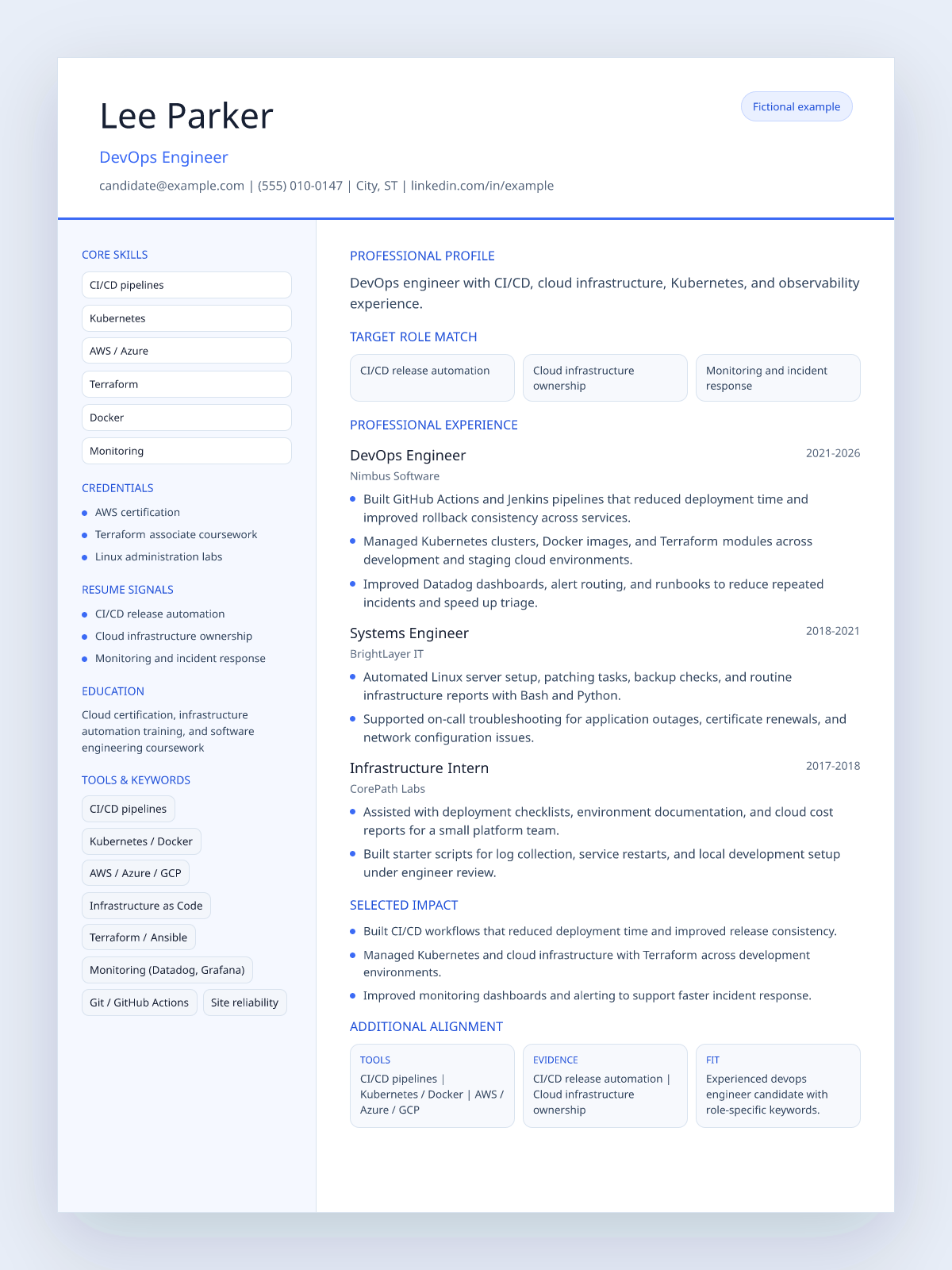
These terms appear frequently in devops job postings. Your tailored resume will reflect the specific language used in the role you paste.
See how generic language becomes specific, concrete, and relevant to the role.
Worked on infrastructure and helped the team deploy faster.
Built and maintained CI/CD pipelines using GitHub Actions and Jenkins that reduced average deploy time from 40 minutes to 8 minutes, managed Kubernetes clusters across three AWS environments using Terraform for infrastructure provisioning, implemented Datadog dashboards and alerting that reduced mean time to detection for P1 incidents by 35 percent.
Upload your current resume as a PDF or DOCX, or fill in your details using the built-in form. It is saved to your library and reused for every application.
Copy the full job posting and paste it in. The tool reads both your resume and the posting to decide what to highlight and rewrite.
Get a complete application package: tailored resume, cover letter, ATS match score, and interview prep. All in under a minute.
Can't I just use ChatGPT for free?
ChatGPT is a general text tool — it doesn't have your resume, the specific job description, or any context about ATS formatting. Resume Tailor+ takes both your resume and the job posting, rewrites your content around that specific role, and outputs a formatted resume, cover letter, keyword gap analysis, and interview prep in the same generation.
See the full comparison →I already have a resume.
That's the starting point, not the problem. A general resume sent to multiple jobs is one of the main reasons applications don't hear back. Resume Tailor+ rewrites your existing content around each specific job description, keeping your real experience while aligning your language to what that employer actually asked for.
Do ATS systems actually matter?
Most mid-to-large employers use applicant tracking systems to filter resumes before a recruiter sees them. If your resume doesn't include the right keywords and formatting, it may not reach a human at all. Resume Tailor+ gives you an ATS match score and shows you exactly which keywords are missing so you can fix them before applying.
Will this work for my field or situation?
Resume Tailor+ tailors output to the specific job description you paste in, which means it adapts to any role, industry, or experience level. Whether you're changing careers, returning to work after a gap, or applying for a senior position, the result is based on what that specific employer asked for — not a generic template.
Start with 3 free resume generations. No credit card required.
Tailor My DevOps ResumeCI/CD pipeline experience (tools and scope), cloud platform expertise (AWS, Azure, GCP), infrastructure-as-code (Terraform, Ansible, Pulumi), containerization and orchestration (Docker, Kubernetes), monitoring and observability tools, scripting languages (Python, Bash, Go), and any SRE or on-call experience if applicable.
Describe your on-call responsibilities, the monitoring and alerting systems you have built or maintained, incident response work you have done, and any improvements to reliability metrics such as uptime, MTTR, or deployment failure rate.
Yes, if you have them and if the job description places weight on cloud certifications. List them in a credentials or certifications section near the top alongside your technical skills.
Yes. New accounts include 3 complete tailorings at no cost. No credit card is required.
Upload your resume, paste the job description, and get a DevOps resume tailored to that specific role in under a minute. Start with 3 free generations.
Tailor My DevOps Resume